
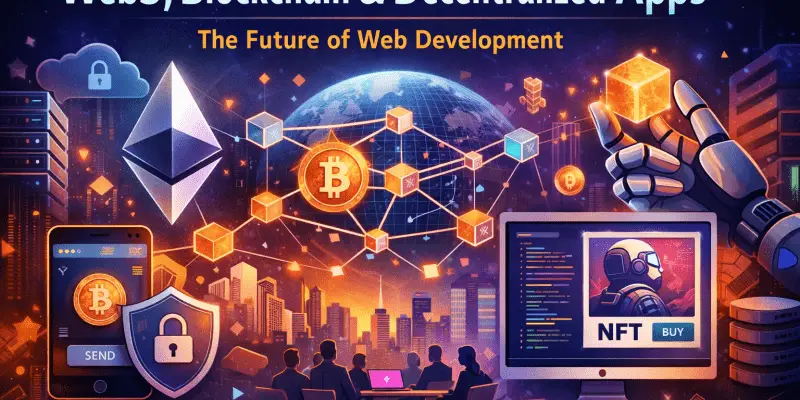
What Is Web3?
Web3 is the third generation of the internet, designed to remove reliance on centralized entities and empower users through decentralized networks.
Evolution of the Web
- Web1 – Static websites, read-only content
- Web2 – Interactive platforms, social media, cloud apps (centralized control)
- Web3 – User-owned data, decentralized applications, blockchain-powered systems
In Web3, users interact directly with applications using cryptographic wallets instead of traditional logins. Ownership and control are distributed across the network rather than held by a single organization.
Understanding Blockchain Technology
Blockchain is the foundational technology behind Web3. It is a distributed digital ledger that records transactions securely and transparently across multiple nodes.
Key Features of Blockchain
- Decentralization – No single authority controls the system
- Immutability – Once data is recorded, it cannot be altered
- Transparency – Transactions are publicly verifiable
- Security – Cryptography protects data and transactions
Popular blockchain networks used in web development include:
- Ethereum
- Polygon
- Solana
- Binance Smart Chain
- Avalanche
These platforms allow developers to deploy smart contracts and build decentralized applications.
What Are Decentralized Applications (dApps)?
A decentralized application (dApp) is a web or mobile application that runs on a blockchain network instead of centralized servers.
How dApps Differ from Traditional Apps
| Traditional App | Decentralized App |
|---|---|
| Central server | Blockchain network |
| Company-owned | Community or user-owned |
| Can be shut down | Resistant to censorship |
| Password login | Wallet-based login |
dApps typically use modern frontend frameworks like React, Vue, or Next.js, while the backend logic is handled by smart contracts deployed on a blockchain.
Smart Contracts Explained
Smart contracts are self-executing programs stored on the blockchain. They automatically enforce rules and execute transactions when conditions are met.
Benefits of Smart Contracts
- No intermediaries
- Faster transactions
- Reduced costs
- High transparency
Common Use Cases
- Token creation
- NFT minting
- Automated payments
- Voting systems
- DeFi protocols
Popular smart contract languages include Solidity, Rust, and Vyper.
Core Components of a Web3 Application
1. Crypto Wallet Integration
Users authenticate using wallets instead of email and passwords.
- MetaMask
- Trust Wallet
- WalletConnect
2. Blockchain Network
Handles transactions, smart contracts, and data verification.
3. Tokens & Cryptocurrencies
Used for payments, incentives, governance, and access control.
4. Decentralized Storage
Instead of traditional databases, Web3 apps use:
- IPFS (InterPlanetary File System)
- Arweave
- Filecoin
These systems store files in a distributed manner, improving reliability and censorship resistance.
Real-World Use Cases of Web3 & dApps
Decentralized Finance (DeFi)
DeFi platforms replace traditional banks by offering:
- Lending and borrowing
- Crypto exchanges
- Yield farming
Examples include Uniswap, Aave, and Compound.
NFTs (Non-Fungible Tokens)
NFTs represent unique digital assets such as:
- Digital art
- Music
- Certificates
- Gaming items
Web developers build NFT marketplaces, minting platforms, and galleries using Web3 technologies.
Blockchain Gaming
Blockchain-based games allow players to:
- Own in-game assets
- Trade items freely
- Earn real value
Popular examples include Decentraland and The Sandbox.
Decentralized Autonomous Organizations (DAOs)
DAOs enable community-driven governance where decisions are made through smart contracts and token-based voting.
Decentralized Identity (DID)
Web3 allows users to control their digital identity without relying on centralized authentication providers.
Web3 Development Stack (Trending)
Frontend
- React / Next.js
- Ethers.js / Web3.js
- Wagmi
- RainbowKit
Blockchain Tools
- Hardhat
- Truffle
- Foundry
Storage
- IPFS
- Arweave
- Filecoin
This stack enables developers to build scalable and secure decentralized applications.
Security Challenges in Web3
Despite its advantages, Web3 comes with challenges:
- Smart contract vulnerabilities
- High transaction fees
- Scalability issues
- Regulatory uncertainty
- Complex user experience
Best Practices
- Smart contract audits
- Secure wallet management
- Multi-signature wallets
- Thorough testing
Why Web3 Is Trending in Web Development
Web3 is gaining momentum because it offers:
- Greater user privacy
- Digital ownership
- Transparent systems
- Reduced reliance on centralized platforms
- New monetization models
As adoption grows, businesses are actively seeking developers with Web3 skills.
The Future of Web3 & Decentralized Apps
The future of Web3 includes:
- Layer-2 scaling solutions
- Lower gas fees
- Improved UX
- Integration with AI and IoT
- Mainstream adoption
Web3 is still evolving, but it is already reshaping how the internet works.
Conclusion
Web3, Blockchain & Decentralized Apps represent a major shift in web development. They bring decentralization, transparency, and user ownership to the forefront of digital innovation.
For developers, learning Web3 opens doors to new opportunities and future-proof careers. As the technology matures, decentralized applications are set to become a core part of the modern web.